
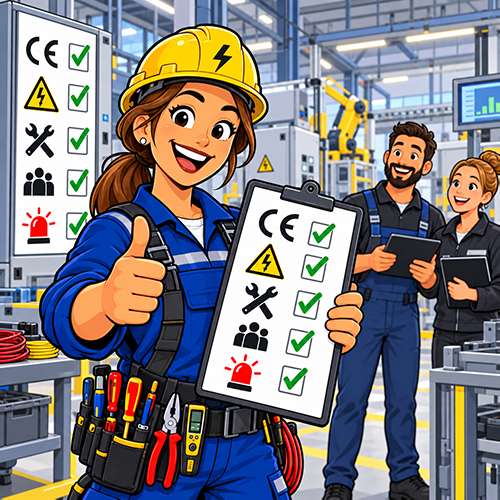
CE answers another question
A new machine arrives on the production floor with a CE marking, a declaration of conformity, and manufacturer documentation. This ensures that the product is properly documented. However, another task must still be completed to ensure safe operational use. The employer must organize usage, hazards, access, authorization, maintenance, inspection, modifications, and training in such a way that the machine can be used safely in a real-world environment. Product conformity and electrical safety in the workplace are therefore not the same thing.
The integration creates new interfaces
At the installation site, the machine is connected to a specific power supply, protective devices, equipotential bonding, and often to operational emergency stop or control systems. This integration can give rise to electrical requirements that are not explicitly stated in the CE marking alone. Furthermore, the suitability of the upstream power grid, protective parameters, and installation testing must be appropriate for actual use. After all, even a perfectly documented machine can still be connected incorrectly.
Inspection and operation remain the employer’s responsibility
To the extent that the Industrial Safety Regulation, DGUV Regulation 3, and relevant technical rules require inspections or organizational measures for a specific case, these requirements remain in effect. Particularly in the case of modifications or changes in operating modes, electrical specialists must be able to assess whether protective measures, inspections, documentation, or compliance limits are affected. Technical knowledge from ten years ago is not automatically sufficient for this purpose.
Technical knowledge must be up-to-date and task-specific
DIN VDE 1000-10 focuses on professional qualifications for electrical engineering-related activities. What matters, therefore, is not a status acquired once and for all, but rather suitability for the current task. The ES certification allows for the structured updating of knowledge regarding protective measures, inspections, modifications, and operational organization. It does not replace practical experience or operational authorization, nor is it equivalent to regular training.
The Practical Benefits
When electrical specialists can jointly evaluate manufacturer documentation, the condition of the equipment, and operational requirements, approvals become more reliable. Changes are identified earlier, inspections are prepared more effectively, and the distinction between the machine product and the on-site installation remains clear. That is precisely where the value of good ES maintenance lies.
Checkpoints
- Separate the product from the operation
- Review Site Integration
- Evaluate protective measures
- Classify changes by subject area
- Keep Your Professional Knowledge Up to Date
Conclusion
CE marking is important, but it is no substitute for safe electrical installation practices. Qualified electrical specialists must be able to professionally assess the specific integration and use of the machine. ES training helps keep this knowledge up to date for new systems and modifications.
Leave A Comment