
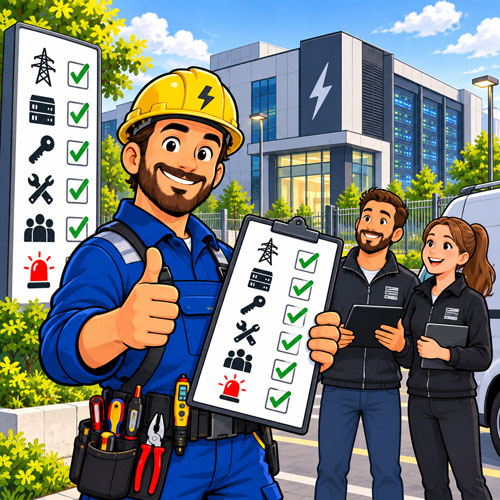
Good design does not necessarily mean good business organization
A data center can be technically well-designed yet still reveal organizational gaps shortly before it goes live. Redundant power supplies, UPS systems, generators, batteries, and protection concepts do not automatically address who monitors the equipment, who is authorized to perform switching operations, how system activations are organized, and what qualifications are required for each task. Design compliance and operational electrical safety are two separate work packages that must be integrated in a timely manner.
The transition begins long before the handover
Decisions that will shape future operations are made, at the very latest, during construction and commissioning. Access points, switching devices, isolation procedures, testing concepts, maintenance, and lines of responsibility should therefore not be considered only shortly before Ready4Service. A responsibility matrix must align with the qualification framework and operational procedures. Otherwise, the result will be a building that is technically complete but not yet organizationally ready for safe use.
Understanding the Rules in the Right Context
Legal employer obligations, accident prevention regulations, and technical standards serve different purposes. The Industrial Safety Ordinance requires, among other things, appropriate organizational measures to ensure the safe use of work equipment. DGUV Regulation 3 addresses electrical systems and equipment. DIN VDE 0105-100 provides rules for the operation of electrical systems. A standard is not a law, but it can be very important for proper organization. Clearly distinguishing between these levels prevents both oversteering and unnecessary bureaucracy.
Operational capability must be verifiable
For the future organization of operations, it is not enough to simply compile manuals and test reports. The responsible personnel must have a thorough understanding of the actual facility, its operating conditions, and operational procedures. This also includes temporary configurations and outstanding issues from the commissioning phase. The documentation should therefore demonstrate that technical documentation, operational procedures, and expertise are indeed aligned.
Interim CRES as Reconstruction Assistance
If the future operator does not yet have a fully established internal electrical organization, an external electrical engineering firm (CRES) can provide interim support during construction, commissioning, and the transition to operation. A prerequisite for this is genuine integration with a defined scope of responsibility and decision-making authority. The goal should not be to permanently establish an external role, but rather to stabilize procedures, responsibilities, and competencies in such a way that a robust internal handover becomes possible.
Checkpoints
- Equipment Inspection
- Switching and Disconnection Processes
- Qualifications Framework
- Test Plan
- Transfer Points
Conclusion
Data centers do not become operationally responsible for electrical systems only when the first load is applied. The electrical infrastructure must grow in parallel with the technical system. An interim CRES can provide expert guidance during this transition phase if a viable internal structure is not yet in place.












Leave A Comment