
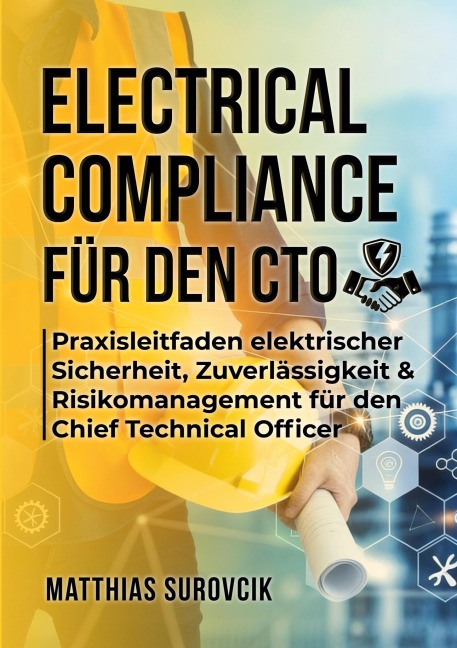
Electrical Compliance for the CTO: Why Electrical Responsibility Remains a Top Priority and How to Ensure It Meets Audit Standards
In industries with global reach, simply complying with local regulations is no longer enough. Customer requirements, audits, and supply chain compliance demand demonstrable electrical compliance; and in the event of an incident, the focus is not just on a single location, but on the organization as a whole. This is precisely where the new book “Electrical Compliance for the CTO” comes in: as a practical guide that combines electrical safety with reliability and risk management —with a focus on leadership principles.
The Book at a Glance
- Title: Electrical Compliance for the CTO
- Subtitle: A Practical Guide to Electrical Safety, Reliability, and Risk Management for the Chief Technical Officer
- Length: 176 pages (paperback)
- Publisher: MS Verlag
- Published: February 2026
- ISBN-13: 9783943247176
Why “Electrical Compliance” Is More Than Just Electrical Safety Today
Electrical compliance is not a single measure or a folder in SharePoint. In practice, it means:
- Structures that clearly define responsibilities (even across locations)
- Processes that operate under time pressure (including those involving outside contractors)
- Control logic that is audit-ready and triggers in the event of deviations
- Documentation that makes decisions more reliable
The book articulates the core concept very clearly: As CTO, you are responsible for results— selection, organization, and oversight. Delegation can lighten your load, but it does not replace responsibility.
The typical sticking point: Responsibilities are “somehow” delegated; unfortunately, not effectively
In many companies, the electrical organization has “evolved over time.” On paper, everything is assigned, but in reality, there are still gaps:
- Responsibilities are unclear or overlap
- The transfer of obligations is formal, but lacks genuine enforceability
- Inspections are sporadic rather than systematic
- Management of outside companies depends on individual people
- Audits are handled through special initiatives, not routine procedures
The risk: Electrical compliance “takes care of itself” until a malfunction or incident reveals that it wasn’t actually being maintained.
What Sets This Book Apart: Electrical Compliance as a Management Responsibility
“Electrical Compliance for the CTO” describes how to establish a structured compliance framework—with a properly appointed chief responsible electrical specialist (CRES), clear responsibilities, a well-defined delegation of duties, and a monitoring system that works across all locations.
1) Effectively appoint the CRES—don’t just name it
A CRES is effective only when roles, responsibilities, escalation procedures, and resources are aligned. The book explicitly links the CRES to leadership and control mechanisms, rather than treating it as a “technical end point.”
2) Systematic Delegation of Responsibilities: Authority + Oversight
Delegating responsibilities is not an end in itself. What matters is the logic behind it:
- Who decides what?
- Who checks what, how often, and based on what criteria?
- What happens if there are discrepancies?
It is precisely this control mechanism that the book describes as an essential part of the organization, ensuring that it functions effectively even across locations, with external contractors, and under time pressure.
3) Auditability results from repeatability
“Audit-ready” means not just “well-documented,” but robustly reproducible. If your system works in day-to-day operations, the audit becomes a side effect—not a project.
Who Will Find This Book Particularly Valuable
If you…
- be responsible for technology across all locations,
- Making decisions under risk,
- We must consider plant availability and workplace safety together,
- regularly work with audits, customer requirements, or corporate guidelines,
…then this book addresses precisely the intersection between technology, organization, and responsibility: electrical compliance as a robust management discipline.
Practical Benefits: Three Takeaways from the Book
1) A Clear Vision for Your Electrical Department
Instead of “we’ll figure it out somehow,” you’ll get a structure that clearly maps out responsibilities, roles, and interfaces—including the role of the CRES.
2) A logic that makes incidents less likely
Those who simply “let electrical compliance run its course” are more likely to experience a malfunction or incident. Those who take the lead in it make it predictable.
3) Documentation that supports decisions
When decisions and controls are documented in a reliable manner, this not only reduces operational risks but also strengthens management’s position in critical situations.
FAQ
What Does Electrical Compliance Mean in Industrial Facilities?
Electrical compliance encompasses the verifiable, organization-wide implementation of electrical safety requirements, roles, responsibilities, delegation of duties, controls, and documentation—particularly as they relate to audits and the supply chain.
What role does the CRES play in electrical compliance?
The CRES plays a central role when it is effectively established: with a clear description of its responsibilities, authorities, interfaces, and a system of oversight that is embedded in management.
Why isn’t delegation enough?
Delegation can lighten the load, but it does not replace responsibility. Management remains responsible for selection, organization, and oversight.
In a Nutshell
If you don’t want to treat electrical compliance as a “side issue” but rather as an audit-ready management responsibility, “Electrical Compliance for the CTO” is the perfect place to start: concise, practical, and organization-focused.
Available from: bookstores and online retailers (ISBN 9783943247176), such as your local bookstore or Buch 7 (click).













Leave A Comment