
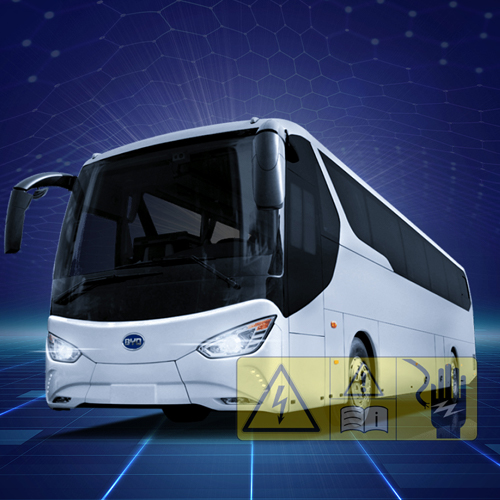
Level S – not for work on (ev) high voltage?
It is clear that qualification in accordance with DGUV I 209-093 is required for work on and with high-voltage vehicles, which can take the form of high-voltage training.
But what about drivers of electric buses or electric trucks? After all, the vehicles are considered intrinsically safe, isn’t a driver’s license enough?
No, because it is the fundamental duty of the employer or entrepreneur to instruct his employees regarding hazards and safe handling of all work equipment, as required by § 12 ArbSchG and § 4 DGUV Regulation 1. This obligation to instruct also applies to electric buses or electric trucks as high-voltage vehicles. This is why level S (or level E) exists as awareness training.
First of all, the employer does not have to do this himself, he can also assign the duty to instruct according to level S to his managers or other suitable employees.
The responsibility of the respective persons themselves results from § 13 ArbSchG, the requirement for the transfer of tasks from §§ 7 ArbSchG as well as 7 and 13 DGUV Regulation 1.
All instructions must be suitable (§ 12 ArbSchG, § 4 DGUV Regulation 1) and all persons must have the necessary aptitude for safety (and health protection)(§ 7 ArbschG, § 7 DGUV Regulation 1).
In addition, the requirements of DGUV Regulation 3, in particular § 3 (requirements for persons) must be met, which means that the respective suitability is also and especially required in the case of substitution and responsibility within the meaning of § 13 ArbSchG, including for instructions.
In the case of (ev) high voltage sensitization of drivers according to level 1S, DGUV Information 209-093 makes it clear that a person with level 1S who has received basic instruction can also carry out sensitization. A fully qualified specialist for high-voltage systems or electrical specialist is therefore not formally required for this, but is recommended, as the instruction must offer the opportunity for further questions and it must be ensured that the instructor is technically suitable for this.
If a company decides to instruct drivers about high-voltage hazards in accordance with level S, either itself or through a manager without proven high-voltage knowledge (e.g. through 2S/2E or at least level 1S/1E), this is still better than not instructing at all, but in the event of an accident at the latest it would constitute organizational negligence on the basis of Section 823 BGB.
As an employer and manager, therefore, always ensure that the person instructing you is sufficiently qualified for (ev) high voltage awareness training.
Our goal in every single high-voltage training course is simple: we want every person who has completed an HV (ev) qualification with us to be able to work safely on HV systems, taking care of the safety of themselves and their colleagues.
We offer all high-voltage courses, such as the aforementioned “Specialist high voltage (ev)” course (level 2S/ level 2E) or the short course to become a “Specialist high voltage (ev) instructed person” (level 1S/ level 1E). More information on this can be found on our homepage www.tcs-engineering.de In addition to a number of open seminars, we also offer customer-specific in-house seminars: Your high-voltage training from us for you!









Leave A Comment