
🔌 Equipotential bonding in high-voltage systems: what you need to know about this core element of high-voltage electrical safety
Equipotential bonding in the (ev) high voltage system is a central element of electrical safety in high-voltage vehicles. In every well-founded (ev) high voltage training course training, the measurement of equipotential bonding is therefore a mandatory component – both within HV (ev) components and between different high-voltage components of an electric vehicle.
🔍 What is measured?
Specifically, it is about the electrical resistance between the conductive housings of any two (ev) high voltage components. This so-called equipotential bonding resistance is measured using a milliohmmeter based on the precise four-wire measurement – not to be confused with the three-wire measurement for grounding resistance measurement.
📏 Legal requirements according to UN ECE R 100
According to section 5.1 of UN ECE R 100 the resistance between two exposed conductive parts must not exceed 0.1 Ohm. This is a very strict regulation – with good reason.
⚠️ Safety in the event of a fault
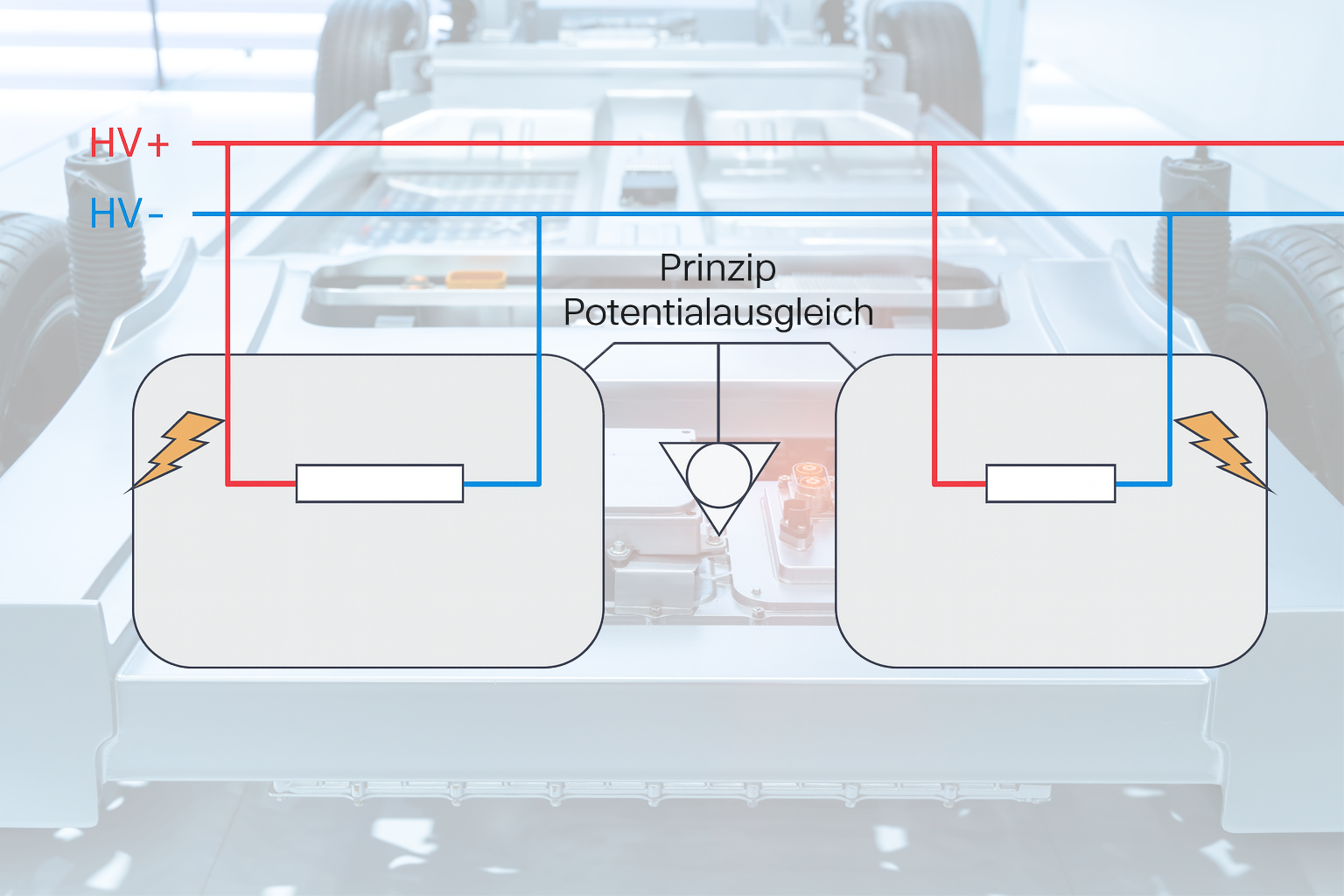
The HV on-board electrical system of modern electric vehicles is an IT-like network in which HV+ and HV- are galvanically isolated from the vehicle ground and the operating equipment. This means that there is no dangerous current flow in the event of a single short circuit (e.g. HV+ to earth).
However, high-voltage safety should also work reliably in the worst-case scenario:
If a second short-circuit occurs (e.g. HV (ev) at another point), a short-circuit current is generated that must flow via the equipotential bonding and safely trigger the HV fuse. Prerequisite: The equipotential bonding is functional and sufficiently resilient.
🛠️ Further task: Fault detection through insulation monitoring
Functioning equipotential bonding is also a prerequisite for the insulation monitor to be able to detect faults anywhere in the vehicle – even if insulation monitoring only takes place at one point. Equipotential bonding electrically connects all housings with each other – and therefore enables faults to be detected in good time.
🎓 Conclusion:
Equipotential bonding in the high-voltage system is more than just compliance with standards – it is an active protective measure on which the entire safety concept of an electric vehicle is based. No wonder that measuring equipotential bonding is a standard part of every high-quality (ev) high voltage training course.
Equipotential bonding thus fulfills central safety tasks in the (ev) high voltage vehicle and is therefore so important in high voltage training courses. PS: Our recommendation: Our free(REALLY free, even WITHOUT having to provide an email address!) paper “6 things you need to know in advance about the high-voltage qualification of your employees” is available here (click).












Leave A Comment